

Reclaiming the Current
Stephen L. Hayes and Javier Wallace
Join us to learn about this exciting new project by two Duke faculty. Hear about their project launch last summer in Barbados, and learn about their goals for growing the project over the next several years. Find out how you can get involved.
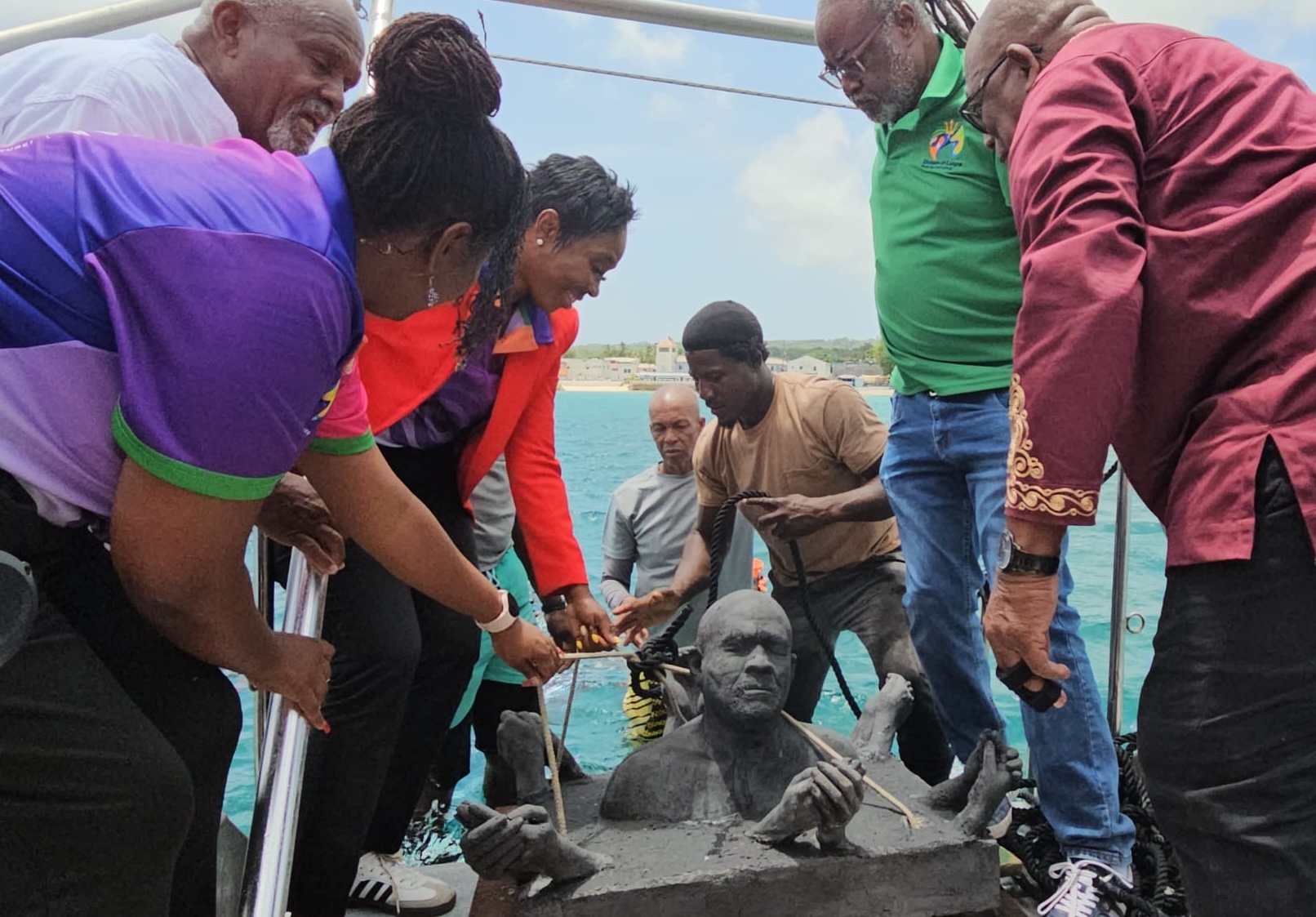
This project is more than art—it is memory, history, and global connection. It invites communities worldwide to engage with their histories of enslavement, reckon with the past, and honor the resilience and humanity of those who endured it.
Dinner by Boricua Soul will be provided for attendees.
This program is hosted by the Forum @ FHI, with additional support from the Department of African & African American Studies, the Department of Art, Art History & Visual Studies, and the Program in Education at Duke University.
Background: Renowned sculptor Stephen Hayes, MFA and cultural storyteller Javier Wallace, PhD have joined forces to create a series of underwater sculptures intentionally dedicated to enslaved Africans and their descendants. This living memorial is a groundbreaking way to honor the African diaspora—rooted in truth, humanity, and artistic innovation.
The project began during Hayes’s residency at Black Rock Senegal, where he envisioned “collaborating with the water” at historic ports connected to the transatlantic slave trade. At each location, Hayes will cast at least two descendants of the enslaved—people whose family histories are tied to that place. The sculptures are then submerged in local waters for one year. Over that time, the ocean becomes an active collaborator, transforming the work through coral growth, salt, and tide.
After a year, the sculptures are retrieved and placed on pedestals, carrying the story of their journey. They will then travel to museums and galleries worldwide, forming a powerful, collective narrative of the African diaspora.
Dr. Javier Wallace ensures each installation is rooted in meticulous historical research, centering the humanity of Africans who were forcibly taken from their families, communities, and continents. Using archival data, including slave ship records, the project connects each sculpture to specific stories, voyages, and people.
The inaugural chapter launched in partnership with the Barbados Division of Culture in June 2025, honoring the legacy of King Cuffee. On June 12, 1675, enslaved Africans in Barbados planned a rebellion to overthrow the brutal slave system and install Cuffee as king. The plan was discovered, and many were executed or tortured.
Exactly 350 years later, on June 12, 2025, two sculptures were submerged 22 feet beneath the waters of Speightstown, Barbados, following a moving ceremony and public program. These sculptures will remain in place until June 2026, when they will be raised from the ocean, transformed by the sea, and displayed publicly.
Learn more on the project website.
Information about parking and entering the building, much of which can also be found here:
We apologize in advance that parking might feel challenging, and we hope this guidance might help a little. Note that the South side of the building is the one closer to Chapel Hill Street. The North side is the side closer to the railroad tracks.
-
If you have a pass to park anywhere on Duke’s campus, we request that you park in one of the gated lots on the South side of Smith Warehouse. Your use of those spaces will free visitor parking and non-gated spaces for our visitors who don’t have access to a pass.
-
If you need accessible parking, there are a few spaces adjacent to Smith Warehouse outside Bay 4 and Bay 2. Ramp access is through Bay 6.
-
The closest designated visitor parking is in the metered lot which is at the corner of Buchanan Blvd and Maxwell Ave (the designation for the road that runs along the south side of the building, connecting Buchanan Blvd with Campus Drive). These meters are active 24/7, and the rate is $2/hr. Payment is through Duke Blue Spot. There is a scannable QR code on a sign at the entrance to the lot.
-
Free visitor parking is across Buchanan Blvd. The easiest way to prepare to use one of those lots is to consult the map and locate the blue circled areas to the east and northeast of the building. (Thanks to DHRC @ FHI for compiling this info on their website.)
check us out
on social media